What Falls Out: A Starter Archive of Things Left in Library Books
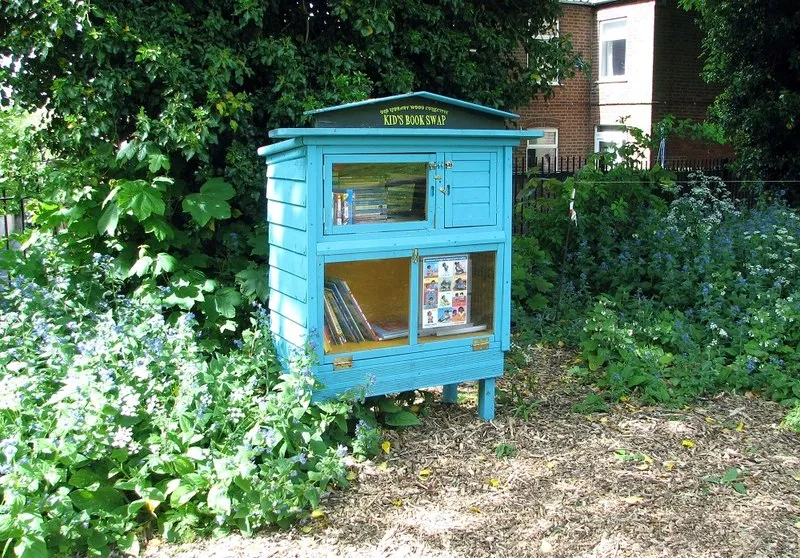
Photo: Evelyn Simak , CC BY-SA 2.0, via Wikimedia Commons
A hardcover came back to the return bin last month with a single fortune-cookie slip inside it, wedged at page 147, reading: You will travel far, but not necessarily today.
The librarian laughed. Then she put it in a small tin behind the desk with the other things.
That tin is where this project starts. Every library I have ever asked about has one — sometimes a drawer, sometimes a shoebox, sometimes a big manila envelope labeled FOUND IN BOOKS in marker, getting heavier every year, emptied of nothing. Nobody knows what to do with a slip of paper that is not library property and not identifiable and, clearly, not trash either.
So consider this the opening entry in a Bemeyers Mawl archive. An accidental-artifact survey. A field guide to what America is using as bookmarks.
How This Started
I asked a favor of two libraries and got a stranger's whole Tuesday in return.
In one branch the tin contained: a grocery list in two handwritings, a pressed maple leaf so dry it flaked when I touched it, a coupon for forty cents off a product discontinued in 2021, a boarding pass stub from Tampa, a pediatric appointment reminder card, and a photograph of a dog nobody could identify because the dog had been photographed from underneath, mid-yawn.
In the other: a bus transfer, a church bulletin with a funeral circled in pencil, a folded ten-dollar bill that had clearly been in there long enough to soften, and a laminated card with two phone numbers on it and the words IF I AM NOT HOME CALL MY SISTER.
I had intended to write something clever about forgotten bookmarks. Instead I sat in a parking lot thinking about how much of a town you can read from what it puts between pages.
The Grocery List
The most common species, and the least interesting at first glance, until you read the handwriting carefully.
The typical grocery list is a vertical column on the back of an envelope, with the first four items in one pen and the last two in a different pen, added later, in a parking lot, in a hurry. Somewhere in the middle is one item that does not belong — dog food, milk, batteries, Jodie's field trip form, apples.
What gets flagged is a list that has been checked off completely. All boxes marked. Nothing missing. Those come from a very specific chapter of a week, and you can feel the small satisfaction in the dark pen marks. The unchecked ones are better company. They are unfinished business, abandoned in the fiction aisle, and they say plainly that a person's day did not go the way the list planned.
The ones with prices scribbled in the margin are my favorites. They mean somebody was doing arithmetic on their feet and using the inside of a paperback as a desk because the book was already in their hand and the answer had to go somewhere.
The Emergency Contact
This is the category that makes the archivists go quiet.
Emergency Contact items are the pieces of paper that were never meant to be leisure material — appointment cards, insurance slips, a bank envelope with an account number on it, a pill schedule on a pharmacy printout, a laminated index card with a sister's phone number. They are not sentimental. They are structural. Somebody took them out of a wallet or a purse and slid them into a book for safekeeping because they needed both hands, or because the book went in the bag and the bag had to be put down, or because they were reading at a kitchen table with a phone call happening at the same time.
We have found hospital bracelets. We have found a prescription slip with a doctor's office hand-drawn map on the reverse, which — if you can read the map — is the most personal document in the entire tin.
The rule of the archive: no phone numbers are published, no full names, nothing that could reach a real person. The point is not to know who. The point is to notice how often the things we cannot afford to lose end up holding down page 212.
The Time Capsule
And then there is the sentimental species, which is really a small and hopeful kind of vandalism.
Photographs, mostly. Kids' drawings, folded in thirds. A pressed flower that has gone completely the color of paper. A ticket stub from something meaningful — a game, a concert, the last night of something. Graffiti in pencil at the margin reading this part is true. A birthday card used as a bookmark on the exact page where somebody stopped reading.
The Time Capsule items all share one quality: they were placed deliberately. Somebody chose to leave them, or to keep them there, and then returned the book anyway, which suggests they figured it would come back, or that they wanted it to keep living in the building. Either way, it's a deposit. A small thing left in the care of the public.
Fortune-cookie slips belong here too, in the back slot, where they have clearly been used as bookmarks for months and probably considered.
Three Smaller Species Worth Knowing
The Receipt — a CVS receipt of such length and emotional weight that it becomes a landmark. Either a bookmark or a warning.
The Pressed Leaf — universally intended as a bookmark, universally forgotten, and always from a tree suspiciously close to the library parking lot.
The Expired Coupon — usually a decade out of date. Always for something the store no longer carries. Never thrown away. It has been keeping a place for someone's spot since before the current building was renovated.
Send Us Yours
Here's the ask. If you find something between the pages of a secondhand book, a thrift-store paperback, or a library book you brought home this month, describe it. Send the phrase, the handwriting, the item, the page number if you remember. Do not send anything that identifies a person — cover the numbers, blur the names, keep the mystery intact.
If the item seems important and not romantic — a card, a check, a document — do the decent thing and hand it to the front desk first. The archive can survive losing a specimen. Somebody's Tuesday cannot.
The purpose is small and honest: to build a record of what a town keeps inside its books. It is not a grand survey. It's the tin behind the desk, opened up, sorted, and held to the light — the same tin every library has been quietly keeping for you, waiting for someone to ask.