Reading the Shelf: What Corner-Store Clearance Rows Say About a Town
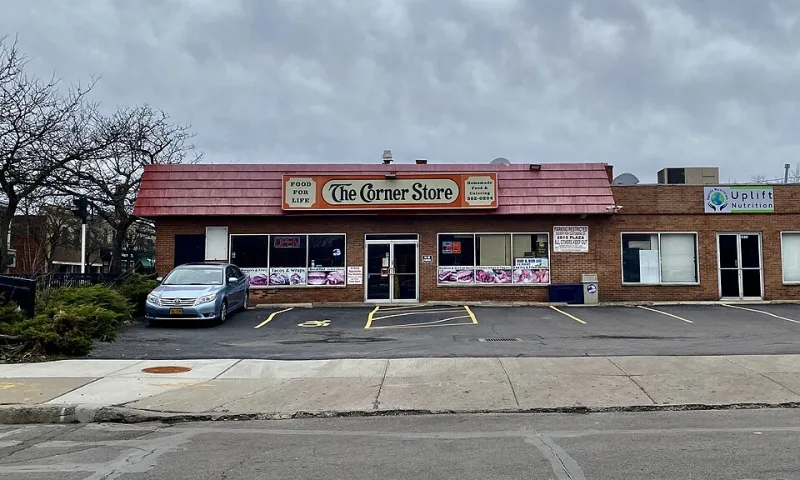
Photo: Andre Carrotflower, CC BY-SA 4.0, via Wikimedia Commons
There is a shelf in the back of a store on Route 6 that has held the same tin of sardines for, I am estimating, three years. The tin has a handwritten sticker on it that says $1.29 and, beneath that, in different ink, 75. Nobody has bought it. Nobody has thrown it out. It has become furniture. I go in about once a month and check on it the way you check on an elderly relative.
That shelf is the most honest document in town.
The Shelf as a Found Archive
I am not going to pretend the clearance shelf is a museum. It is a business decision made in a moment of optimism and quietly abandoned. But it functions like an archive anyway, because it accumulates according to rules nobody wrote down and nobody can override: things that did not sell but were too expensive to toss, things a distributor pushed with a tempting case price, things the owner's cousin thought would move, things that arrived with a date code that made everyone nervous.
What you get is a stratified deposit of local taste. Read the layers and you learn what this corner of the county will and will not eat.
At mine, the bottom layer is dust-covered sea-salt caramels from a company that no longer exists. The middle layer is a rotating cast of regional sodas—the kind that only appear when a distributor's truck has room. The top layer is seasonal: tiny bags of candy corn in November, marked down twice, then quietly absorbed into a bowl by the register.
How to Read a Clearance Shelf (A Field Method)
Go at an odd hour. Mid-afternoon on a Tuesday, the shelf has not been picked over and the owner has time to talk.
Start with the stickers. A printed barcode sticker with a slash through it means the store is doing this by the book. A handwritten price in ballpoint means someone stood there with the item in hand and made a judgment call. Two prices, one written over the other, means the item has failed at least twice, which makes it interesting. Three prices means it has become a landmark.
Then look at the dust. Dust is a clock. A thin film of it says weeks. A soft gray coat says months, and the item beneath has crossed over from merchandise into landscape.
Finally, check what is missing. Gaps on a clearance shelf are the good news: someone wanted the weird thing. A shelf with no gaps for six months is not a shelf, it is a storage unit with ambitions.
What Ends Up There, and Why
Mostly, three categories.
The over-ordered. The case was cheaper per unit, and the case held twenty-four. Three sold. Now the store owns twenty-one jars of a relish nobody asked for.
The discontinued. The manufacturer changed the recipe, the packaging, or the name. The old stock went on the shelf because the distributor would not take it back. This is where you find the regional flavors that quietly vanish and then show up on eBay at four times the price.
The hopeful mistake. Someone ordered a novelty item because a customer asked, and the customer moved away. I have seen a shelf hold an entire case of pickle-flavored cotton candy on this basis. I have thought about it for two years.
Questions Worth Asking the Person Behind the Counter
This is the part most people skip, and it is the best part. Owners and clerks are usually delighted to explain the shelf, because nobody has ever asked them to.
- Where did this one come from? Was it a special order, or did it just show up?
- How long has it been here? (You will get an estimate, and the estimate will be generous to the store.)
- What is the weirdest thing that ever sat on this shelf?
- Does anything ever sell off it that surprises you?
- Who are your regulars, and what do they buy that I would not guess?
- Do distributors ever push things on you that you knew would not move?
Ask those six questions in six different stores and you will have a better map of the local economy than most spreadsheets provide. The answers will mention a guy, a church group, a school fundraiser, a summer festival, a customer who used to come in every Tuesday. That is a town describing itself.
The Micro-Economy of a Handwritten Sticker
The clearance shelf is where accounting gets personal. A case of something costs the store real money. Discounting it is an admission, and admitting you were wrong is expensive in a business with thin margins and a small customer base.
So the discount comes in stages, and the stages are a kind of negotiation with reality. Full price. Then a dollar off. Then half. Then whatever the owner thinks the item is worth to a person who would actually want it, which is often a number with a story behind it. I have seen a jar marked down to a quarter because the owner's kid liked the label and wanted it gone before they ate it.
Those stickers are the most readable thing in the building. They are somebody's judgment, in pen, on the record.
Why It Feels Like a Letter
A chain store's markdown aisle is designed. There is a planogram. An independent store's clearance shelf is not designed; it is remembered. Every item on it represents a small decision somebody made and then had to live with, and the result is oddly intimate in a way no corporate shelf can be.
So next time you stop for ice and coffee, walk to the back. Read the stickers. Ask about the sardines. Then buy something ridiculous for a dollar and change, because the shelf is a conversation, and conversations need both people to show up.